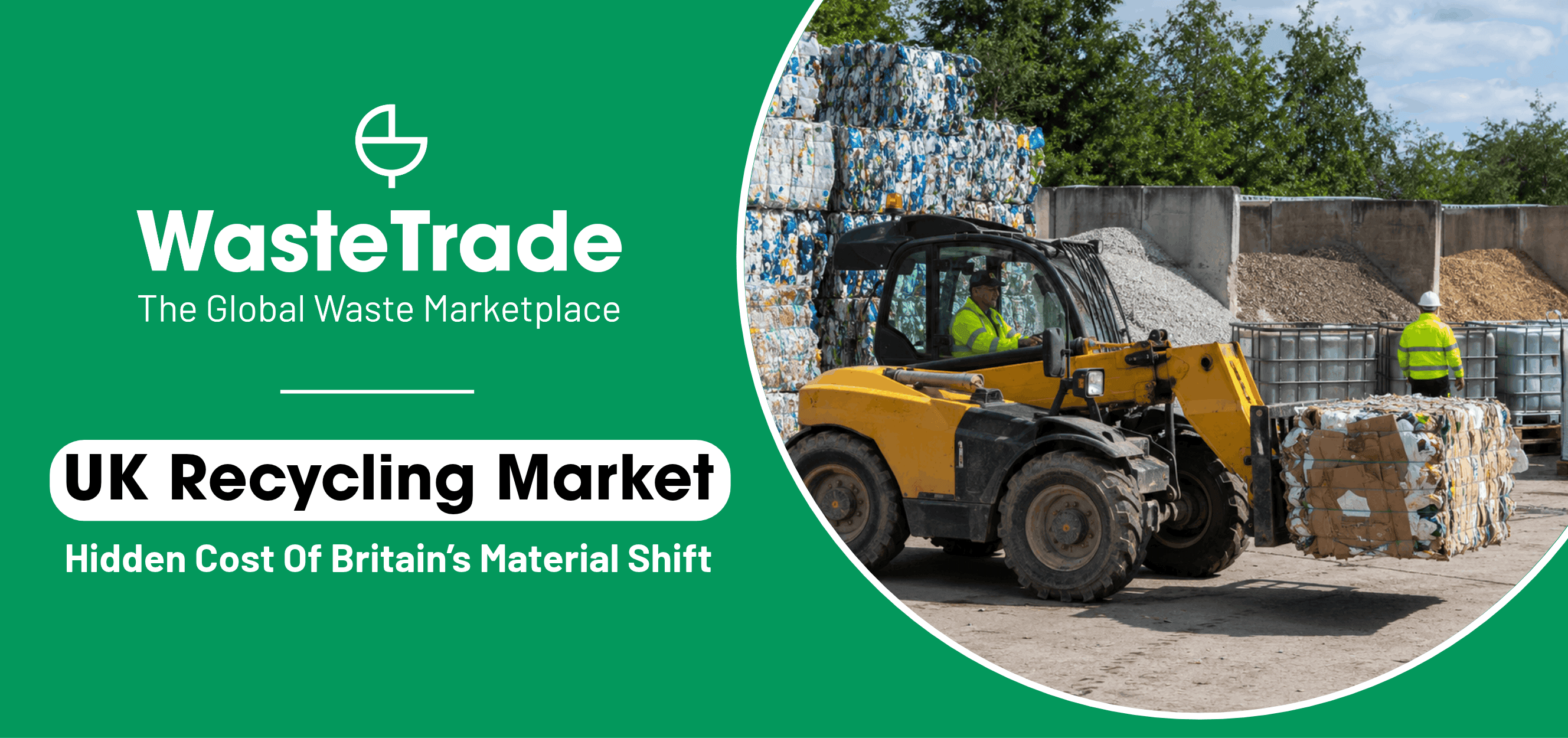
UK recycling market reforms promise more recovered material, but they could deprive established sorting plants of their most profitable tonnes. Official figures show a lower packaging recycling rate in 2025, while forthcoming deposit returns will redirect valuable bottles and cans. A Birmingham paper mill has been marked for closure even as new plastics facilities open. For waste contractors and material buyers, the question is no longer simply how much Britain collects, but whether the material can find profitable, lasting outlets.
UK Recycling Market: Key Information
- UK packaging recycling fell from 73.2% in 2024 to 70.5% provisionally in 2025.
- In 2025, steel reached 88.5%, paper and card 80.3%, glass 75.1% and plastic 57.3%.
- A 2026 industry study estimates that 22% of UK plastics recycling capacity disappeared between 2023 and 2025.
- In an illustrative sorting-plant model, PET and aluminium supply 39% of sales income from 12% of incoming weight.
- The commercial test is material quality, net delivered value and dependable downstream demand, not collection tonnage alone.
UK Packaging Recycling Rates Expose a Material Divide
Defra records approximately 7.8 million tonnes of UK packaging recycled in 2025, against 11.1 million tonnes placed on the market. Its provisional figures concern packaging, not all UK waste. [1]
Plastic's reported rate rose from 53.5% to 57.3%, although paper, glass, aluminium and wood recorded declines. Recycling performance is not the same as commercial value.
That distinction is becoming central to the UK recycling market. A tonne of clean PET bottles has a different buyer, margin and processing route from a tonne of damp mixed paper or contaminated film.
Plastics Recycling Capacity: Expansion and Retrenchment
Ceres, in a study commissioned by Viridor, estimates that the UK lost 260,000 tonnes of plastics recycling capacity between 2023 and 2025, around 22%. It cites weak recycled-polymer prices and rising costs. This is an industry estimate, not an official capacity census. [2]
Yet Eurokey announced a new £20 million Corby facility in November, with projected throughput of 38,000 tonnes of plastic packaging annually, not verified current output. [3]
The UK recycling market is therefore gaining some new outlets while losing others. The net effect depends on which grades the plants can accept, how reliably they run and whether manufacturers buy their output.
Recovered Paper: A Closure That Matters Beyond Packaging
In June, Smurfit Westrock confirmed plans to close Birmingham's SSK mill, which produced around 200,000 tonnes of fluting and liner annually. That measures finished paper, not recovered-paper intake. The company planned to transfer production to other European sites. [4]
A replacement buyer may demand different grades, offer less or require longer transport. WasteTrade's paper guidance likewise shows why preparation matters more than the generic label 'waste paper'. [12]
PET and Aluminium: The Deposit Return Shock
Under legislation for England and Northern Ireland, a deposit return scheme starts on 1 October 2027, redirecting eligible drinks containers through dedicated returns. Other UK nations have distinct arrangements. [5]
Cleaner returned containers may help manufacturers, while depriving materials recovery facilities (MRFs), which sort mixed recyclables, of valuable feedstock.
CIWM studied a representative MRF where PET and aluminium comprised about 12% of input weight but 39% of material-sales income. If 80% of those containers were diverted, the model suggests sales income could fall by more than 30%. This is a scenario, not a national forecast. [6]
Materials Recovery Facilities: Less Value Per Tonne
Income per tonne matters more than throughput alone. Labour, plant and compliance costs persist after valuable materials leave. Without contract provisions adjusting for material composition, operators may absorb the loss.
CIWM warns that reforms could also change the mix of paper, glass and films entering sorting lines. Its illustrative model finds that diverting 90% of aluminium drinks cans would raise aerosols from 2% to 9% of the remaining aluminium fraction, without increasing their actual quantity. That figure does not establish a hazardous-waste classification, but it raises questions about handling and buyers' acceptance rules. The UK recycling market could collect more yet earn less per processed tonne. [6]
Extended Producer Responsibility Changes the Cost Calculation
Packaging extended producer responsibility makes obligated producers fund specified waste-management costs. From 2026 to 2027, PackUK's fee modulation charges more for poorly recyclable packaging and less for better-rated formats; actual liabilities depend on confirmed fees. [7]
Yet a lighter package can leave sorting costs unchanged, while fibre composites may require specialist treatment. The recyclability rating is not a guaranteed buyer.
Plastic Film Collections: The 2030 Bottleneck
England intends to postpone mandatory household and workplace film collections until 1 April 2030, subject to legislation. Local Government Association research estimates that 392,000 tonnes of film enters household waste annually, while councils collect about 15,000 tonnes for recycling. [8]
The delay gives recyclers preparation time but cannot conjure buyers for mixed wrappers. WasteTrade's LDPE guidance highlights the importance of polymer grade and contamination. [13]
Glass and Steel: High Rates Do Not Guarantee Strong Returns
Steel's 88.5% and glass's 75.1% packaging recycling rates say little about the margin on a load. Glass can be costly to transport; contamination and metal grade alter scrap value. [1][14] Glass markets are not uniform either: in 2026 at least 76% of a producer's glass recycling obligation must be met through remelt evidence, rather than lower-value alternative applications. Specifications and end use therefore matter as much as tonnage. [15]
For the UK recycling market, the essential distinction is between successfully recycling a material and securing a commercially sustainable transaction to make that recycling possible.
Advanced Recycling: Plans Are Not Operating Capacity
Endolys proposes a £125 million Darlington plant with potential full-build-out intake of 120,000 tonnes of plastic film annually, producing pyrolysis oil. Public records show planning approval and an Environment Agency permit consultation, not verified operation. As of 19 November 2026, the records reviewed do not establish an issued permit or confirmed commissioning date. [9][10]
Suppliers still need agreed specifications, permits, start dates and gate terms. Forecast capacity is not an operating outlet.
Recycled Material Prices: The Delivered-Tonne Test
Bale quality, moisture, haulage, rejections and payment terms determine net value. The cheapest quoted tonne may not be the cheapest usable tonne.
WasteTrade's global marketplacehelps businesses compare buyers for defined grades. Its logistics services connect the full journeyfrom collection to deliverywith the underlying trade. Cross-border deals also require the correct classification and shipment documents, with consent where applicable. Compare compliant offers on equivalent specifications, not unrelated headline prices.
Material Traceability Becomes Commercial Evidence
PET buyers need source, grade and verifiable records, not just a photograph of a bale.WasteTrade is developing digital material passportsto link batch identity, composition and custody, while counterparties retain their compliance obligations. [11][16]
That evidence helps resolve disputes and support claims about the material's onward use.
UK Recycling Market: The Next Commercial Test
The UKrecycling markethas no single shortage: some materials need better collections, others need buyers or contracts resilient to falling commodity income.
Buyers and sellers should secure specifications, audit delivered costs and avoid depending on announced capacity. Contracts should identify who pays for rejected loads, how quality is sampled and what happens when incoming material changes after the deposit scheme begins. The meaningful measure is material that finds a repeatable market.
References
[1] Defra, UK Statistics on Waste, September 2026
[2] Ceres, Reimagining Recycling, June 2026
[3] Eurokey, Corby Recycling Plant Announcement, 13 November 2026
[4] Smurfit Westrock, Birmingham Paper Mill Closure, 29 June 2026
[5] The Deposit Scheme for Drinks Containers Regulations 2025
[6] CIWM, Can UK MRFs Survive Packaging Reform?, October 2026
[7] PackUK, Packaging EPR Modulated Fees Policy
[8] Local Government Association, Plastic Film Collection Research, August 2026
[9] Endolys, Project Update, July 2026
[10] Environment Agency, Endolys Permit Consultation
[11] WasteTrade, PET Recycling
[12] WasteTrade, General Paper Recycling
[13] WasteTrade, LDPE Recycling
[14] WasteTrade, Aluminium Can Recycling